
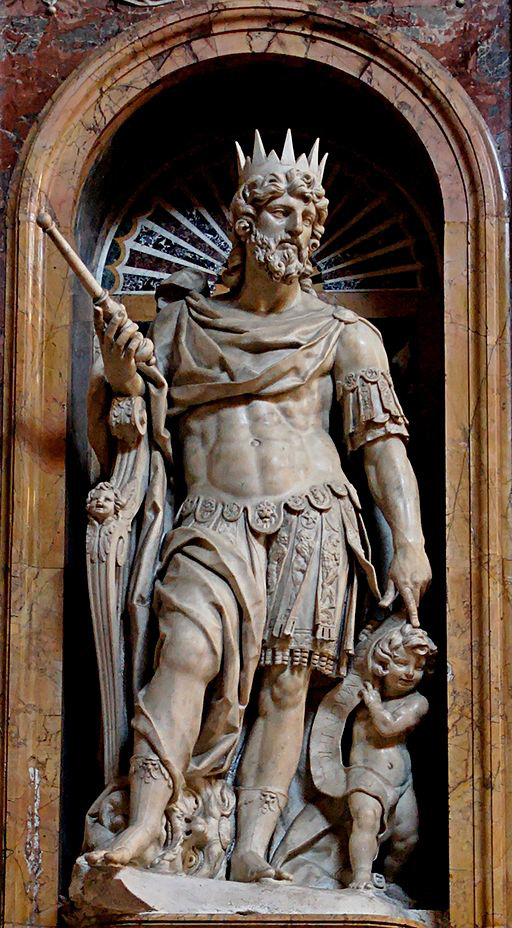
Statue of King David in the Borghese Chapel of the Basilica di Santa Maria Maggiore.
King David’s Exchange with Abigail, Wife of the Rich but Evil Nabal
When evil-dealing Nabal disrespects David by denying him his request for assistance, Nabal’s wife, Abigail, intercedes for her husband and convinces David that shedding her husband’s blood, her own, and that of Nabal’s household is not a wise move for a man [David] so blessed by the God of Israel.
Finding out about her husband’s insulting attitude toward David’s messengers and her husband’s refusal to assist the mighty David, Abigail hastily gathers a large number of food rations and makes an offering of appeasement directly to David herself, behind her husband’s back.
Seeing Abigail coming up the mountain to meet him, David said, “Perhaps I was wrong to protect everything this fellow [Nabal] has in the desert wilderness and to command that nothing of his be taken; yet he repaid me evil for good. May God do so and more to David, if I leave even one male of all belonging to Nabal until the morning.” (1 Kingdoms 25: 21-22, The Orthodox Study Bible; 1 Samuel 25: 21-22). This passage leaves little doubt in the reader’s mind that David intends to kill the entire household of Nabal, including his servants.
Upon meeting David and his men, Abigail gets down from her donkey and prostrates herself before David. She then takes ownership of her husband’s bad behavior and intercedes for him before David. Then, in a brilliant move, she reminds David of his status before the Lord and God’s ultimate intention for David to rule over Israel.
She states, “And when the Lord has done for my lord all the good things He said concerning you, and He has appointed you ruler over Israel, will this not be an abomination to my lord and an offense to my lord, to have shed innocent blood without cause, for my lord to have avenged himself?” (1 Samuel 25: 30-31)
Struck by her wisdom, David responds, “Blessed be the Lord God of Israel, who sent you to meet me this very day! And blessed is your conduct and blessed are you, because today you kept me from coming to bloodshed and from avenging myself. But as the Lord God of Israel lives, who kept me from hurting you, if you had not hastened and come to meet me, surely I say that by morning light not one male would have been left to Nabal. So David received from her hand everything that she had brought him and said to her, ‘Go up in peace to your house. See, I have heeded your voice and respected your presence’” (1 Samuel 25: 32-35).
The takeaways I get from this interaction between David and Abigail are:
• God sometimes uses women to accomplish what a man would be unlikely to accomplish. Compare Abigail’s interaction with David with what would have likely transpired between David and Napal should Abigail not have been directed by the Lord (as David stated) to intervene.
• David acknowledges that Abigail, despite being a woman, was sent by God to intercede and prevent him from shedding innocent blood, “Blessed be the Lord God of Israel, who sent you to meet me this very day!” (1 Samuel 25: 32). We can only imagine what God’s response to David would have been had he not listened to Abigail, but instead, took her life and those in her household.
• David, who would become the greatest king in the Old Testament, not only allows Abigail to speak, but he listens to her and respects her, “See, I have heeded your voice and respected your presence” (1 Samuel 25: 35). This documents that women were not always viewed as inferior by men in Scripture, not by King David and certainly not by our Blessed Lord Jesus Christ, who was not only fully Divine but also fully human.
 Female Orthodox Saints